


Marketing Compliance Disclaimer: Garrison Everest does not promote or encourage the unlawful use of firearms. All marketing strategies and content are developed in accordance with federal and applicable state laws, including FTC guidelines and advertising standards for the firearms industry.
For firearms and shooting-sports brands, e-commerce is now a core part of their business, not just an auxiliary channel. The post-pandemic market has permanently shifted consumer behavior toward digital-first purchasing, and this trend is unlikely to change. Customers now expect the same speed, clarity, and confidence they find on Amazon when shopping for firearms, accessories, and completing compliant transactions. Any online experience that causes delays or friction will drive them away.
At the same time, the competitive landscape has tightened. While the federal environment may feel more stable following the election cycle, digital competition has intensified. Search Generative Experience (SGE), AI-driven shopping assistants, and zero-click answers mean visibility is no longer just about ranking—it’s about credibility and authority in AI systems. A website alone does not compete anymore. Authority does.
Layered on top of this is continued pressure at the state and financial level. De-platforming has not disappeared; it has become more fragmented. Local regulations, compliance complexity, payment scrutiny, and tracking requirements are now part of the operational reality for any serious online firearms business.
Winning in 2026 requires discipline and foresight. From regulatory readiness to the technical foundation needed to compete in an AI-driven marketplace, there are a few non-negotiables you must get right before you launch. Below are the five must-dos to protect your business, scale revenue, and stay competitive online.
In this article, you’ll learn about:
- How to build your firearms ecommerce website for your ideal customer
- The importance of preparing your product library
- Identify product fulfillment methods
- Security issues
- Should you consider an enterprise solution?
eCommerce Statistics You Need to Know Before Launching
Understanding the latest eCommerce trends (Source: Fortunly) is critical before launching your firearms website. Here are some compelling data points to keep in mind:
Updated eCommerce Statistics for 2026
-
70.19% of online shopping carts are abandoned before checkout — This global average remains structurally high. On mobile, abandonment rates are even more severe, often exceeding 80%. The leading causes are still unexpected “extra costs” at checkout (48%) and mandatory account creation (26%).
-
9 out of 10 customers (90%) say free shipping is the top incentive that makes them more likely to shop online. In 2026, free delivery is no longer a perk; it is the primary factor consumers use to choose one retailer over another.
-
53% of mobile users still abandon a site if it takes more than 3 seconds to load. However, 2026 benchmarks suggest that even a one-second delay can now slash conversions by up to 7%, as consumer patience has thinned alongside the rise of high-speed 5G networks.
-
Global eCommerce sales are forecast to hit $6.88 trillion in 2026 — Representing approximately 21% of all retail sales worldwide. Niche industries, including firearms, are seeing growth as “hybrid retail journeys” (researching online, buying for FFL pickup) become the standard.
-
85% of shoppers continue to research products online before making a purchase. In 2026, this research increasingly happens via AI-driven search (SGE), making detailed and “helpful” product descriptions critical for being discovered by AI agents.
-
U.S. consumers now expect at least 3 to 5 product photos and, increasingly, a 360-degree view or video snippet. Visual density is a key trust signal; a lack of varied imagery is often equated with a lack of legitimacy.
-
71% of shoppers now demand stricter transparency regarding ingredients, origins, and business practices. With trust in brands generally declining, building “digital trust” through verified reviews and clear FFL/compliance disclosures is your most valuable currency.
-
84% of shoppers are convinced to buy after watching a video. Product demos and “how-to” content remain the highest-converting formats. By 2026, video streaming is expected to account for over 91% of all internet traffic.
-
67% of customers will switch to a competitor after just one poor experience. In a 2026 market defined by “loyalty through experience,” your post-purchase communication (tracking info, support) is what prevents churn.
-
Nearly 3 billion people (approx. 2.9 billion) are expected to shop online by 2026. The move to digital-first habits is permanent, making it the most opportunistic time for firearms brands to refine their online presence.
In this post, I want to give you five critical “must-dos” (before you consider how to generate traffic) if you’re evaluating a new e-commerce website initiative that will help you organize your firearms marketing team, save time and make it easier and faster to implement your new e-commerce-based website if you are a manufacturer or retailer.
1. Build Your Firearms Ecommerce Website for Your Ideal Customer
Before you get to the part of what you want your website to look like, nothing will bring your web team more clarity and focus than understanding your buyer persona or ideal customer profile (ICP).
You most likely have a good idea of who your customer is—but taking the time to understand what they want from your website will make all the difference. Seek to understand what their wants, needs, problems, behaviors, and questions are.
Create a web experience based on them and use story to create clear messaging. This will ultimately make for higher sales and less abandoned carts.
2026 Update: The definition of who is “Engaged in the Business” has expanded. In 2026, the ATF’s “Engaged in the Business” final rule is in full effect. This means that if you are selling online with the intent to profit—even at low volumes—you almost certainly need a Federal Firearms License (FFL). Additionally, with the rise of AI-driven search (SGE), your persona research must now include the specific, conversational questions your buyers ask AI assistants. Your content needs to move past simple specs and focus on authoritative, helpful answers that AI search engines can index.
2. Prepare your Firearms Ecommerce Product Image Library
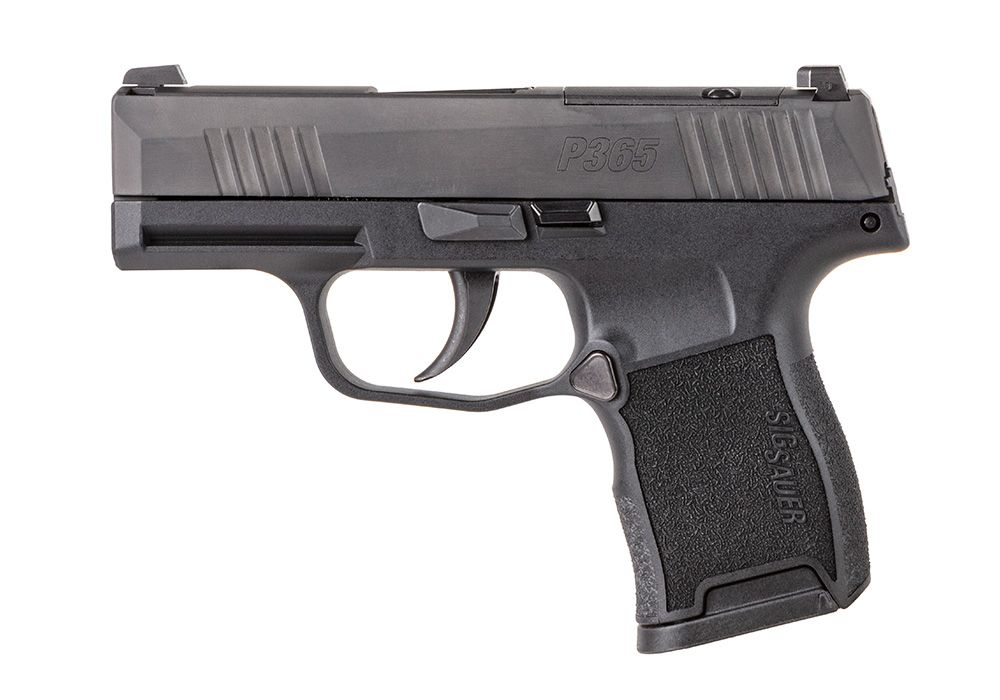
Photograph products on a clean white background.
The second step is establishing your product library. If you’re a large manufacturer, you may have over 2000 SKU’s that are jumbled into a hundred different sizes, on gray backgrounds, outdated, or that show your product in a less than ideal format. Since this aspect of the project can take the longest, you can save a lot of time by starting now.
Start by creating a shot list:
- What products need to be reshot?
- Which product images can be reused?
- Locate a lifestyle photographer
- Have the photographer provide the raw sizes and cropped images set to 1000 x 1000 pixels for use on the website
Sort all these on a spreadsheet so the photographer can easily sort and organize when it comes time to shoot your products. Make sure you place all your products on a white background. Placing products on a clean white background allows your product to be the hero and creates a clear understanding in your customers mind without any unnecessary background clutter.
2026 Update: For 2026, while high-quality stills are the baseline, you should supplement your library with short-form video (30-60 seconds) for every major product. AI-driven shopping experiences now prioritize “video-first” content. Furthermore, if you sell suppressors or SBRs, update your product tags to reflect the 2026 regulatory shift where the $200 NFA tax has been eliminated for these items. Highlighting “Tax-Free NFA” is a massive conversion driver for your library.
3. Identify how you’re going to fulfill orders
With over 20,000+ laws on the books—determining how you want to fulfill orders that comply with federal, state and local laws is the next consideration and if you’re a firearm manufacturer. Below are five considerations.
1. Utilize a third-party cart.
Ruger, for example, utilizes the GearFire, Gallery of Guns.com, and Guns.com and other providers to sell its products directly online. All you need to do is apply for membership with your FFL and set up an account. This can also be done through your distributor. This allows your products to be embedded in hundreds if not thousands of online gun store websites and outdoor specialty retailers and takes the hassle out of you (or your staff) having to deal with running your online store. The downfall is you rely on their shopping cart that doesn’t align with your website’s look and feel.
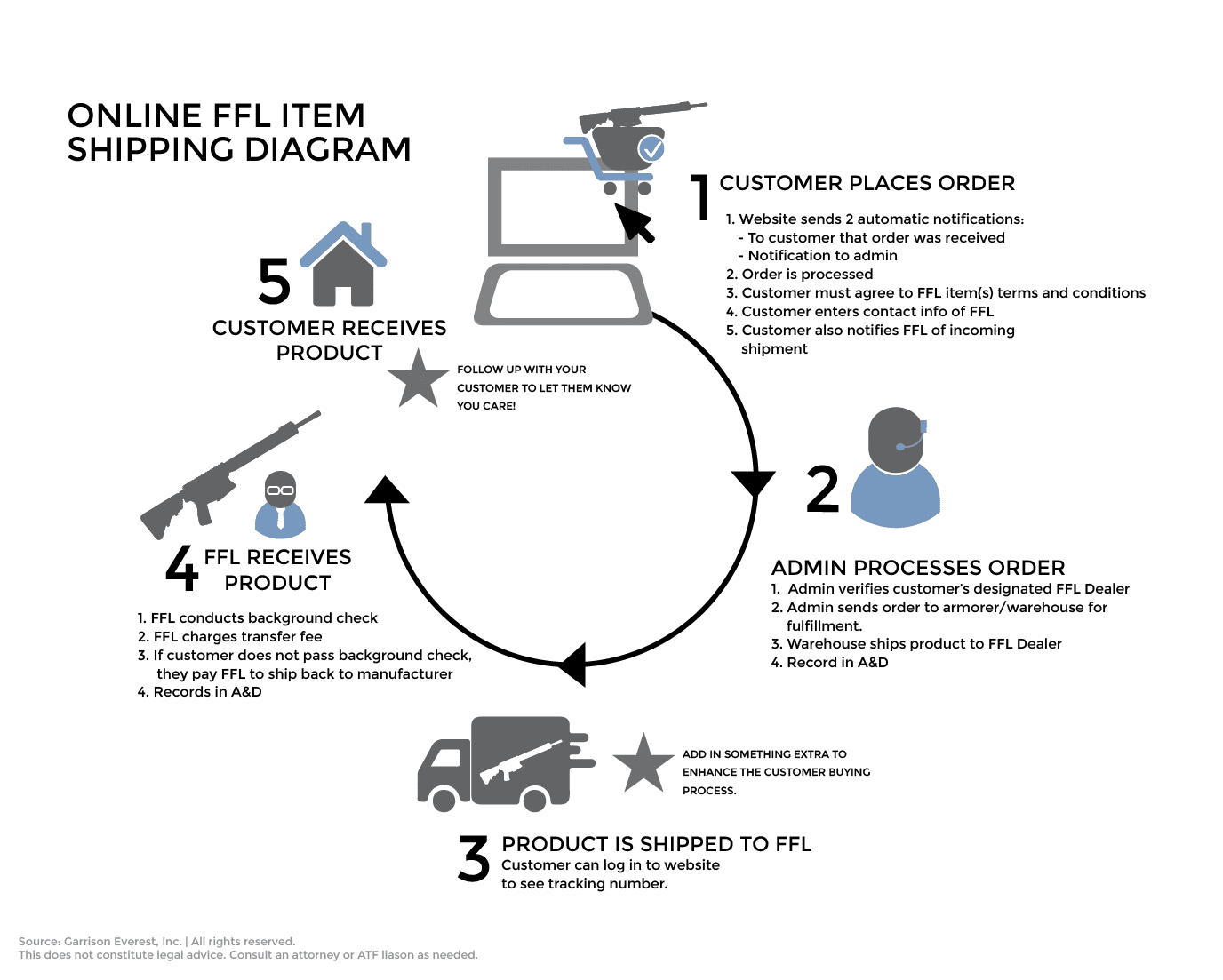
2. Ship direct to customer via an FFL
Daniel Defense’s website is an example of how to set up a shopping cart where the product is shipped directly to an FFL of your customer’s choosing. They will enter their local FFLs address, notify them that your firearm is being shipped to them, and the FFL will handle all the paperwork. This all happens after the purchase. There are hundreds of shopping cart software solutions on the internet from WooCommerce and Adobe Magento to name a few. Choose the software that best suits your needs and one that you feel is easiest to use. I recommend either WooCommerce or BigCommerce.
2026 UPDATE: Payment processors will be your biggest hinderance to selling online. Most of the larger ecommerce platforms are intertwined with processors like Stripe, Square, Paypal and others that restrict firearm sales. I do not recommend signing up with any third-party solutions like Miva, Volusion, Wix, Squarespace, GoDaddy, and especially Shopify, who in August 16, 2018 banned Franklin Armory from using their platform. When building on these networks, you are essentially handing over your lawful online business that puts you at risk because these providers can shut you down at anytime—sometimes without warning. Big Commerce, Adobe/Magento (larger custom sites) and WooCommerce are better options. There are also FFL-based platforms designed for dealers like Celerant and Orchid that can be more suitable for your needs.
3. Dealer only
Springfield Armory, Benelli and Beretta only sell through their dealer network—some use a hybrid (dealer and third-party cart). You can purchase other accessories on their websites, but to purchase a firearm you are redirected to a dealer locator.
4. Which States should I avoid shipping to?
Some manufacturers do not ship to New York, California, Illinois, or Hawaii. About 14 states, including Colorado, Connecticut, Massachusetts, New Jersey, Vermont, and Washington, have magazine capacity restrictions. To reduce risk, you can block certain items based on State IP addresses. Anti-gun laws in these states are complicated and could expose you to legal action.
5. What shipping provider should I use?
The shipping of firearms seems to constantly change. The main rule of thumb is to always ship to an authorized FFL—never to a personal residence. Below is the latest information from GunBroker.com. If you have any questions, it’s always wise to check with your attorney, USPS, UPS or FEDEX representative.
- Eligibility: Restricted strictly to Federal Firearms License (FFL) holders. Non-FFL holders are no longer permitted to initiate firearm shipments via FedEx.
- Requirements:
- Agreement: Shippers must have a signed FedEx Firearms Shipping Compliance Agreement on file.
- Account Executive: All firearm shipping accounts must be approved and managed by a dedicated FedEx account executive.
- Prohibited Items: Firearms and ammunition cannot be co-mingled; they must be shipped in separate packages.
- Discretion: Packages must be plain with no markings, symbols, or text indicating that a firearm is inside.
- Restrictions: FedEx Office and other retail drop-off locations are generally prohibited from accepting firearm shipments; they must be tendered via a scheduled pickup or at a FedEx Express station.
- Eligibility: Only FFL holders (dealers, manufacturers, importers, or collectors) who have entered into a specific contractual agreement with UPS may ship “Firearm Products.”
- Requirements:
- Handgun Service: Handguns must be shipped exclusively via UPS Next Day Air services.
- Service Add-ons: Must use “Delivery Confirmation Adult Signature Required” and “Direct Delivery Only” services.
- Packaging: Use new corrugated packaging meeting UPS strength guidelines. The package must be non-descriptive with no mention of firearms or “Gun” in the shipper/recipient name.
- Ammunition: Must be shipped separately and labeled according to “Limited Quantity” hazardous materials regulations.
- Restrictions: UPS Store® locations, Access Points, and third-party retailers cannot accept firearms. Non-FFL holders are strictly prohibited from shipping firearms through the UPS network.
- Eligibility:
- FFL Holders: May ship handguns (after filing PS Form 1508) and long guns.
- Non-FFL Holders: Prohibited from mailing handguns. They may only mail unloaded rifles and shotguns to an FFL holder in any state or to a resident of their own state (where state law permits).
- Requirements:
- Service Level: Regulated firearms must be sent via a service that provides tracking and signature capture (e.g., Priority Mail Express or Registered Mail).
- Certification: Postmasters may require a written certification that the firearm is unloaded.
- Packaging: No markings of any kind may indicate the nature of the contents.
- Restrictions: Handguns remain non-mailable for private individuals. Short-barreled rifles (SBRs) and short-barreled shotguns (SBSs) are generally prohibited from the mail unless specifically authorized between FFLs.
6. Flat rate or box size?
The easiest and most hassle-free way to ship your products is by weight. You can set-up different weight tiers of pricing for all of your products. However, if you’re in a segment that is highly competitive and $5-$10 is a factor in getting the sale, then be prepared to discount your shipping.
4. Get the Firearms Ecommerce Security Issues Out of the Way
And with every website now a target for hackers, it’s more important than ever. You need a dedicated payment processor or gateway that won’t shut you down for selling firearms. Additionally, you need secure and speedy hosting with a Content Delivery Network (CDN), SSL, and 24/7 backups.
2026 Update: In 2026, standard high-risk processing isn’t enough. You must ensure your payment gateway is compliant with Merchant Category Code (MCC) tracking requirements, which are now mandatory in several states (California, Colorado and New York). Additionally, “Automated ID Verification” is no longer optional. Integrating a service that verifies age and identity in real-time before checkout is now a standard security “Must-Do” to protect your FFL and reduce fraud liability.
1. Payment Processor or Gateway
To take payments online, you first need a payment processor. Authorize.Net acts as the middleman in between you and your merchant bank account that securely transfers funds from your customers’ credit card to your account. During this process, Visa, Mastercard, Amex, and Discover—whatever credit cards you accept on your site all take a percentage of the sale, usually 1.5-2%. Your bank may also charge a percentage as well. Be sure to configure these fees into your product costs.
Do I need under-18 age verification? Yes. Most payment processors and emerging State laws (especially in California and Illinois) now require you to verify age before allowing minors to enter your website.
2. A Secure Socket Layer or SSL is the standard security technology for establishing an encrypted link between a web server and your customer’s browser and is now required on all websites. This link ensures that all data passed between the web server and browsers remain private and integral.
3. Terms and Conditions and Privacy Policy pages are essential in protecting your site from users who may encounter problems. These important legal pages on your website ensure your business is protected from any fraudulent behavior from users. Read here for more information and some horror stories. Always get an attorney to look over your T&C and PP before launch.
4. Secure and Speedy Hosting is usually the last component considered when building your firearms ecommerce website. But beware, there are many services out there who sell you on services and packages you don’t need and who guarantee speed and security but fail to deliver. One #2A friendly company that we recommend is WP Engine. WP Engine provides you with a secure and fast platform to run your WordPress website. For many years, we have enjoyed little to no downtime and fast speeds. With Google now ranking websites based on speed, WP Engine remains a good choice for the firearms industry.
- Content Delivery Network
- Included SSL
- Content Page Performance
- Fast 24/7 Support
- Staging Server
- 24/7/365 Backup
5. Consider a Firearms E-commerce Enterprise Solution
For enterprise manufacturers, it may be time to connect your CRM, ERP, and WMS and eCommerce altogether. Companies like NetSuite, Sage, SAP and HubSpot serve larger companies with large global inventories with complex supply chains. These software solutions allow you to manage your inventories in greater detail and with greater efficiency. If you’re a large manufacturer, taking the time to explore these solutions may be what you need rather than a simple shopping cart. A SAP or NetSuite implementation can cost hundreds of thousands of dollars. If that seems like overkill, there are other solutions that can be connected to your back-office operations and warehouse that tracks inventory, shipping, and accounting – all who are FFL friendly.
In conclusion, when considering your next firearms ecommerce store, it’s important to identify who your buyer persona is, get a good product image library created, identify what kind of shopping cart setup you want, make sure you have the right security components in place to take payments securely and if you’re an enterprise manufacturer, consider a larger solution to more efficiently run your operations.
By taking into consideration these five “must-dos,” you’ll have what you need to engage a firearms web development company and make your website project go much faster.
GET ECOMMERCE HELP
FAQs
1. What are the first steps I should take when building a firearms e-commerce website?
Start by defining your buyer persona—their needs, challenges, and motivations. Build your website experience around the customer journey rather than a generic template. Clarity here improves engagement and conversion rates.
2. How do I prepare a product image library for a firearms e-commerce site?
Organize all product images in a clean, consistent library. Use white backgrounds, consistent sizing (ideally 1000×1000px), and accurate filenames. Create a spreadsheet to track SKUs and image updates before launching your website.
3. What fulfillment methods should I consider for a firearms e-commerce site?
Determine how orders will be fulfilled legally and efficiently. Consider third-party integrations, shipping directly to an FFL, or limiting sales to approved states. Partner with shipping carriers who understand firearm compliance.
4. What security and compliance issues must be addressed for firearms e-commerce?
Implement SSL encryption, secure payment processing, and age verification where required. Review your Terms, Privacy Policy, and compliance with federal, state, and local firearm laws before launch.
5. When should a firearms brand consider an enterprise-level e-commerce solution?
When managing large inventories, multiple warehouses, or complex ERP/CRM/WMS integrations, an enterprise solution such as Cin7, SAP or NetSuite, may be necessary.
6. How can I make sure my firearms e-commerce website loads quickly and performs well?
Choose reliable hosting optimized for speed, compress all images, and use a CDN. A fast, responsive website not only improves user experience but also builds trust with buyers.
7. Can I use META or Google ads to promote my firearms e-commerce store?
No, META and Google restrict firearm-related advertising. Instead, focus on SEO, email marketing, influencer partnerships, and organic social content to drive traffic and conversions.
8. What e-commerce platforms work best for firearms websites?
Platforms like BigCommerce or WooCommerce should be used. Each offers different levels of flexibility, compliance support, and integration options.
9. Why is content and SEO important for a firearms e-commerce website?
Because paid ads are restricted, SEO and high-value content are essential. Blog articles, buying guides, and product education help attract organic traffic and build long-term brand authority. AI will use your information to surface your content and online store.
10. What are common mistakes to avoid when launching a firearms e-commerce site?
Avoid skipping compliance checks, using poor product photography, or ignoring the buyer journey. These missteps can damage trust, increase returns, or lead to legal issues.

