


Quick Answer: AI is changing outdoor industry marketing by compressing campaign creation, analysis, and optimization into a continuous cycle — replacing the slow, manual batches that used to cost brands weeks of momentum. The biggest gains are in paid media, social media, email automation, and performance analytics. What AI doesn’t replace is authenticity: the real-world, in-field credibility that outdoor brands are built on.
The outdoor industry isn’t in crisis, but it’s not in the boom cycle either. Growth is still there — it’s just modest now, and at the same time, margins are tightening. That combination is forcing brands to operate differently than they have over the past decade.
We’re seeing firearms manufacturers lean more heavily into accessories to protect profitability. We’re not expecting any new models this year. Outdoor brands that have traditionally focused on hiking and camping are expanding into hunting to balance revenue streams (I’ve never seen this in my past 20 years). These aren’t random moves. They’re calculated responses to a market with less room for error than it had in 2021.
Understanding the role of AI in outdoor industry marketing is becoming essential as brands navigate these changes.
“In a tighter market, inefficient marketing doesn’t just underperform — it becomes a liability.”
That’s the context AI is entering, making timing crucial. In this article, I outline how we’re adjusting and developing for a landscape that will likely change significantly in six months or less!
Contents
Why AI Matters Right Now — and Not a Moment Too Soon
AI matters to outdoor brands right now because when budgets tighten, there’s less room for slow feedback loops and wasted ad spend. What AI does is compress time and increase clarity — reducing the manual workload while improving how quickly you understand what’s working and what isn’t.
Instead of waiting weeks to optimize a campaign, you’re making adjustments in near real time. That’s not a feature — it’s a structural advantage in a market where speed compounds. At Garrison Everest, we’ve utilized Databox for over 10 years to optimize our clients’ marketing. Now with the release of Genie, we can get quick insights into marketing performance.
At its core, AI is a lever. The outcome is efficiency. And right now, efficiency is what separates brands that grow from brands that stall.
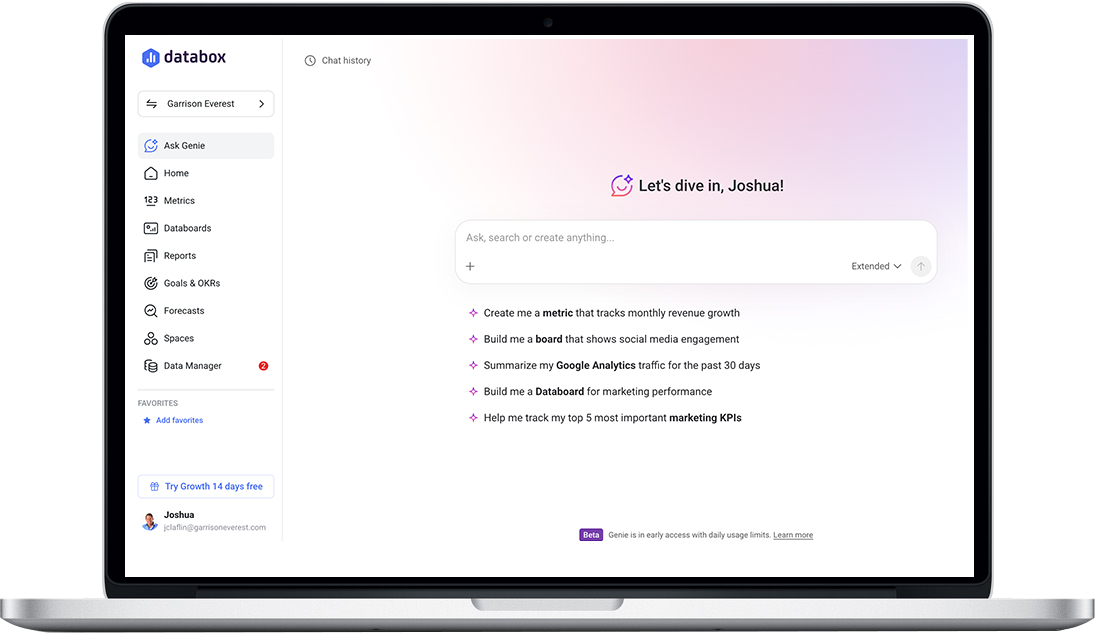
As a Databox Partner, Garrison Everest utilizes Databox to get quick insights into marketing performance.
Where I Am With AI — Fourteen Months in the Field
Over the last fourteen months, I’ve been intentionally deep in this space — not from a theoretical standpoint, but from a practical one. Working directly inside ChatGPT, Claude, HubSpot Breeze, Gemini, Perplexity, HyperAI, Superscale, and Google’s Stitch, testing how they perform in real-world marketing scenarios for clients in the outdoor industries.
I understand the mechanics — LLMs, agent-based workflows, how these tools integrate into a broader marketing ecosystem — but that’s not where the value is. The value comes from the application.
The only question that matters: Do these tools produce better outcomes for clients? If they don’t improve performance, increase efficiency, or create clearer insights, then they’re just adding complexity. And complexity is the last thing most outdoor brands need right now.
What AI Is Actually Changing in Marketing Execution
AI is changing marketing execution by turning a batch process into a continuous one. Historically, a large portion of a team’s time was spent on production and analysis — writing campaigns, pulling reports, interpreting performance, and making incremental adjustments. That entire cycle is now compressible.
Instead of operating in batches, campaigns are created, analyzed, and optimized in motion. With the right systems and SOPs in place, much of that execution runs in the background — freeing teams to focus on strategy, messaging, positioning, and the decisions that actually require human judgment.
That shift — from manual effort to system-driven performance — is where the real advantage is built. Because speed and consistency compound over time, and the brands building that infrastructure now are creating a gap that their competitors will struggle to close.
Where We’re Seeing the Fastest Returns
- Paid media is the clearest win — faster testing, more efficient optimization, and real-time adjustments directly improve return on ad spend and reduce wasted budget.
- Email marketing is right behind it, where AI enables more intelligent automation, better send-timing, and messaging that adapts based on behavior rather than static sequences.
- Social media craft your voice and tone, activate your messaging, link your brand assets, and launch.
- Performance analytics, faster interpretation of data leads to faster decisions, which means resources get reallocated before the opportunity closes.
What AI Does Not Replace
For all of its capabilities, AI doesn’t cross one clear boundary — especially in the outdoor industry — and that’s authenticity. The foundation of this market is still built on real-world experience: time in the field, on the water, on the range, and in the woods.

You cannot replace experience and authenticity in outdoor marketing.
That kind of credibility can’t be manufactured. It has to be lived, documented, and shared by people who are actually using the products in real conditions. What AI does is take that authentic content and make it more effective — ensuring it’s positioned correctly, distributed efficiently, and aligned with messaging that drives action.
“The experience remains human. The system surrounding it becomes significantly more intelligent.”
This is actually one of the places where outdoor brands have a structural advantage over generic DTC categories. The authenticity already exists. AI just gives it better reach and better architecture.
The Real Challenge: Choosing the Right Path Without Creating Long-Term Constraints
The challenge most outdoor brands face right now isn’t understanding AI — it’s deciding how to implement it without locking themselves into a platform that won’t hold its position 6 months from now (yes, only 6 months; it’s changing that fast).
There are more tools available than ever integrating AI: HubSpot, Klaviyo, Canva, Adobe Creative Suite, Databox, Creatify, Topaz, Veed, HyperAI — and they’re all evolving rapidly, each integrating AI deeper into their ecosystems. The natural instinct is to commit fully to one. But that comes with risk. Once-major players in the marketing tech space are being challenged on every front, and what looks like the best option today may look very different by Q1 2027. For example, we started with ChatGPT, but are now moving to Claude.
At Garrison Everest, the strategy extends beyond any individual tool. We’re focused on building systems that can integrate with leading platforms while remaining flexible enough to adapt as the landscape evolves. The tools will change. The strategy cannot. SOPs must be adaptable, tested, and proven in real scenarios across multiple platforms — not optimized for one.
What This Means for Outdoor Brands Right Now
For outdoor brands, the conversation is no longer about whether AI is relevant. It is. The real question is where it creates the most leverage within your current system — and whether you’re building toward that or just adding tools to a stack that isn’t connected.
The brands that answer that question effectively will move faster, operate leaner, and make better decisions because they’re working from clearer, more immediate data. And the brands that succeed long-term will be the ones that maintain their credibility while adopting these systems — because in this industry, authenticity is still the foundation, and no amount of automation replaces that.
The Bottom Line
AI isn’t replacing outdoor marketing. But it is exposing where marketing systems are weak, inefficient, or unclear. It’s forcing brands to look honestly at how they operate and where they can improve.
The brands that respond by building stronger systems, clarifying their messaging, and using AI to execute more effectively will come out ahead — not because they’re using better tools, but because they’re using those tools within a better strategy.
That’s where this is going, and it’s already well underway.
For those of you old enough to remember the dot-com era — it feels a lot like 1999 all over again.
Frequently Asked Questions: AI in Outdoor Industry Marketing
What is AI in outdoor industry marketing?
AI in outdoor industry marketing is the use of artificial intelligence to create, optimize, and analyze marketing campaigns more efficiently. In the hunting, firearms, and outdoor space, this includes paid advertising optimization, AI-powered email automation, performance analytics, and content distribution — all aimed at compressing the time between data and decision while reducing manual workload on marketing teams.
Why is AI important for outdoor brands right now?
AI is important for outdoor brands right now because margins are tightening and growth is leveling out after the boom years of the pandemic era. Brands can no longer afford slow feedback loops, wasted ad spend, or disconnected marketing systems. AI compresses campaign cycles from weeks to near real time, which directly improves performance and reduces the cost of trial and error.
How is AI changing paid advertising for outdoor and firearms brands?
AI is changing paid advertising for outdoor and firearms brands by accelerating creative testing, improving audience targeting, and enabling real-time campaign optimization. Instead of running campaigns for weeks before assessing performance, AI tools allow adjustments in near real time — reducing wasted budget, improving return on ad spend, and eliminating the slow feedback loops that have historically cost brands momentum.
Can AI replace authentic content creators in the outdoor industry?
No. AI cannot replace authentic content creators in the outdoor industry. The credibility that outdoor, hunting, and firearms brands are built on comes from real-world experience — time in the field, on the water, and on the range. That authenticity must come from people who are actually living and using the products. What AI does is take that authentic content and make it more effective through better positioning, distribution, and optimization.
What are the best AI tools for outdoor industry marketing?
The best AI tools for outdoor industry marketing in 2026 we’re using include HubSpot Breeze AI for email automation and CRM intelligence, ChatGPT and Claude for content development, Creatify for video ad creative at scale, and HyperAI for advanced campaign automation. The right combination depends on your existing systems, budget, and marketing objectives — no single tool covers the full stack effectively.
What is the biggest risk of adopting AI in outdoor marketing?
The biggest risk of adopting AI in outdoor marketing is over-committing to a single platform in a landscape that is evolving faster than most SaaS categories. Tools that look dominant today may not hold that position in 6 months. The safer strategy is building systems and SOPs that can integrate across multiple platforms and adapt as the technology changes — prioritizing strategic flexibility over platform loyalty.
Where should outdoor brands start with AI marketing?
Outdoor brands should start AI adoption in paid advertising, email marketing, and performance analytics — the three areas where AI creates the fastest and most measurable return on investment. Paid media benefits from real-time optimization; email benefits from behavior-based automation; and analytics benefits from faster interpretation of performance data. These create immediate revenue impact and build the operational foundation for more advanced AI integration.
How does AI email marketing work for outdoor brands?
AI email marketing for outdoor brands works by automating campaign creation, segmentation, send-time optimization, and performance analysis. Instead of static campaigns sent to broad lists, AI-powered platforms like HubSpot Breeze and ActiveCampaign trigger messages based on individual subscriber behavior — what they’ve clicked, purchased, or browsed — creating personalized sequences that adapt in real time and consistently outperform manual campaigns.
Is AI marketing effective for firearms and hunting brands specifically?
Yes, AI marketing is effective for firearms and hunting brands — and arguably more impactful in this space than in many other categories. Outdoor and firearms audiences are highly segmented, which is exactly where AI-driven targeting and personalization excels. The key is pairing AI efficiency with authentic, experience-based content from real hunters, shooters, and outdoor enthusiasts. The technology amplifies credibility; it doesn’t manufacture it.
How does AI help with SEO and content for outdoor industry brands?
AI helps outdoor industry brands with SEO and content by accelerating research, structuring content for both traditional search engines and AI answer platforms like ChatGPT and Perplexity, and scaling production without sacrificing quality. The most effective approach combines AI content tools with SME interviews from actual field experts — giving AI the authentic source material it needs to produce content that ranks and gets cited in AI-generated answers.
What is the difference between AI marketing automation and a true AI marketing agent?
AI marketing automation follows predetermined rules and triggers — if this, then that. A true AI marketing agent reasons through problems, adapts to new inputs, and coordinates across multiple platforms without requiring manual instruction at every step. In practice, most outdoor brands in 2026 are still working with advanced automation rather than true agents, but the distinction matters for long-term system design and platform selection.
How does Garrison Everest use AI for its clients?
As of this writing, Garrison Everest uses AI across paid media, email automation, social, content production, and performance analytics for clients in the hunting, firearms, and outdoor industries. We’ll evolve this into a full end-to-end agentic growth marketing system that helps clients identify strategy, messaging, guide, install, and manage AI-driven growth systems. The focus for today is on building platform-agnostic systems — integrating AI tools into adaptable SOPs rather than committing fully to any single platform. The goal is measurable performance improvement, not tool adoption for its own sake.

